











The deadlift is one of the three competitive powerlifting movements, alongside the squat and bench press, and is widely regarded as the most complete strength exercise you can do. It trains more muscle mass in a single rep than almost any other lift, which is exactly why it keeps showing up in every serious strength program, from first-timers learning to hinge properly to competitive powerlifters chasing a new personal record.
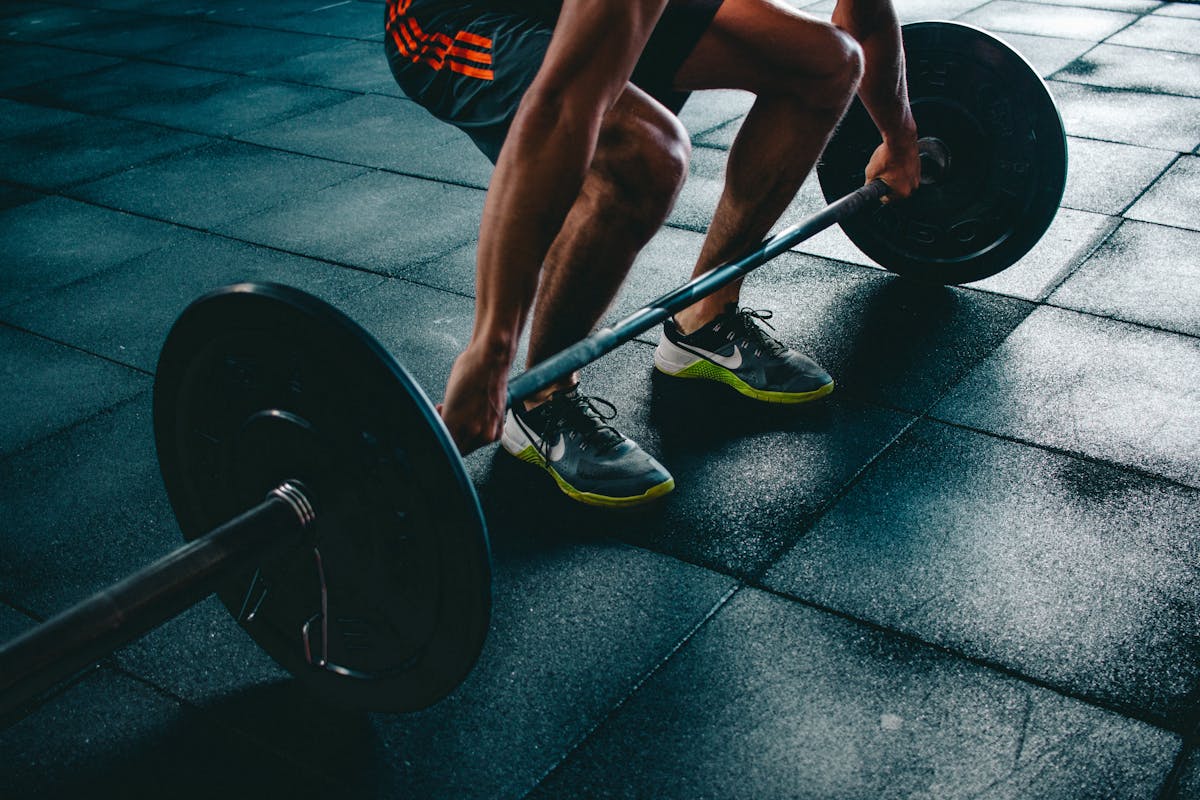
Photo: Victor Freitas / Pexels
What Muscles Does the Deadlift Work?
The deadlift is a hip-hinge movement, not a squat, so the muscles doing most of the work sit along the back of the body — what strength coaches call the posterior chain (Wikipedia, 2026a). According to the American Council on Exercise, the greatest muscle forces during a traditional barbell deadlift are generated at the hip, lumbar spine, ankle and knee, in that order (ACE, 2024).
- Glutes and hamstrings – the primary drivers of the lift. They extend the hip to bring the bar up and control the descent on the way back down (ACE, n.d.).
- Erector spinae (lower back) – runs the length of the spine and works isometrically to keep your back flat and prevent rounding under load (Wikipedia, 2026b).
- Trapezius and latissimus dorsi – keep the bar pulled close to the body and your shoulders packed throughout the pull (NASM, n.d.).
- Quadriceps – drive the initial break of the bar off the floor, particularly in the first few centimetres of the pull (ACE, 2015).
- Core and forearms – your abdominals brace to protect the spine, while your forearms and grip are put under serious tension holding onto a heavy bar for the full rep (Healthline, 2024).

Posterior muscle diagram: derivative of OpenStax Anatomy & Physiology, via Wikimedia Commons, CC BY-SA 4.0 (CFCF, 2015).
How to Perform a Conventional Deadlift
Good deadlift technique keeps the work on your hips and legs, not your lower back. The step-by-step below follows the setup used in ACE’s Exercise Library (ACE, n.d.).
- Set up close to the bar. Stand with feet shoulder-width apart, toes slightly turned out, shins almost touching the bar.
- Hinge and grip. Push your hips back while keeping your chest up and back flat, then grip the bar just outside your knees.
- Brace and set your back. Take a breath, brace your core, pull your shoulder blades back, and make sure your spine is neutral — not rounded, not overarched.
- Drive through the floor. Push your feet into the ground and stand up by extending your hips and knees together, keeping the bar tight against your shins and thighs.
- Lock out tall. Finish standing fully upright with shoulders back — don’t lean backward past vertical.
- Reverse the movement. Push your hips back first, keep the bar close, and lower it under control until it returns to the floor.
A simple starting routine: 3–5 sets of 3–6 reps, with 2–3 minutes rest between sets, is a standard strength-building range once your form is consistent (BarBend, 2024).
Common Deadlift Mistakes (and How to Fix Them)
The lower back accounts for a large share of weightlifting injuries, and research links this specifically to high-load exercises such as squats and deadlifts performed with breakdowns in form (Austin Manual Therapy, 2025). Physical therapists who specialise in barbell athletes consistently flag the same handful of faults:
- Rounding the lower back. This is the most common and most damaging mistake — it shifts load from your hips directly onto the spinal discs and ligaments (Chicago Sports & Spine Institute, 2026). Fix: reduce the weight until you can keep a flat back for every rep.
- Hips too high at setup. This turns the deadlift into a stiff-legged, back-dominant pull instead of a full-body one (Onward Physical Therapy, 2026). Fix: sit your hips down until your shoulders sit just above or in line with the bar.
- Bar drifting away from the body. Reaching forward for the bar forces you to round your back to reach it (Phoenix Rehab Group, 2025). Fix: keep the bar directly over your mid-foot and dragging up your shins.
- Hyperextending at the top. Leaning back sharply to “lock out hard” loads the small joints at the back of the spine unnecessarily (Chicago Sports & Spine Institute, 2026). Fix: finish tall and neutral, not arched backward.
- Adding weight too fast. Progressing load before your technique is solid is one of the most common causes of back strain (The Movement Schopp, 2025). Fix: add weight only when every rep looks identical to your lightest warm-up set.
If pain persists beyond normal muscle soreness, or if you feel numbness, tingling or sharp pain, stop and consult a physician or physical therapist before continuing to train the lift (Dynamic PT, 2026).
Gear for Safer, Stronger Deadlifts
Technique comes first, but the right equipment supports it once the weight gets heavy:
Lifting Belt: A powerlifting lever belt gives your core something to brace against, which helps maintain a neutral spine under load. Might&Glory’s lever belts are one of our most popular picks in the UAE for exactly this reason.
Lifting Straps: Grip is usually the first thing to fail on heavy pulls, long before your legs or back. A pair of heavy-duty lifting straps lets you keep training your hips and back after your grip would otherwise give out.
Training Shoes: A flat, stable sole keeps your base of support solid through the pull. Browse our training shoes and footwear built for heavy lifting rather than cushioned running.
Wrist and Knee Support: If you’re combining deadlift day with other compound lifts, our gym accessories range covers wrist wraps and knee sleeves for added joint support.
The Takeaway
The deadlift trains your glutes, hamstrings, lower back, lats, traps and grip in a single rep — there is no other exercise that works this much of your body at once. Master the hinge, keep your spine neutral, add weight gradually, and gear up properly, and the deadlift will build more real-world strength than almost anything else in the gym.
References
American Council on Exercise (ACE) (2015) 4 Deadlift Variations You Need to Try. Available at: https://www.acefitness.org/resources/pros/expert-articles/5809/4-deadlift-variations-you-need-to-try/ (Accessed: 17 September 2026).
American Council on Exercise (ACE) (2024) The ACE Do It Better Series: The Deadlift. Available at: https://www.acefitness.org/continuing-education/certified/december-2024/8762/the-ace-do-it-better-series-the-deadlift/ (Accessed: 17 September 2026).
American Council on Exercise (ACE) (n.d.) Deadlift, Exercise Library. Available at: https://www.acefitness.org/resources/everyone/exercise-library/6/deadlift/ (Accessed: 17 September 2026).
Austin Manual Therapy (2025) Lower Back Pain After Deadlifts: How to Prevent and Recover. Available at: https://www.austinmanualtherapy.com/blog/Lower-Back-Pain-After-Deadlifts-How-to-Prevent-and-Recover (Accessed: 17 September 2026).
BarBend (2024) Squat Vs. Deadlift: Which Is Better For Strength, Mass, and Power? Available at: https://barbend.com/squat-vs-deadlift/ (Accessed: 17 September 2026).
CFCF (2015) Posterior View of Muscles [Image]. Derivative of OpenStax Anatomy & Physiology. Wikimedia Commons. Available at: https://commons.wikimedia.org/wiki/File:Posterior_View_of_Muscles.jpg (Accessed: 17 September 2026). Licensed under CC BY-SA 4.0.
Chicago Sports & Spine Institute (2026) Deadlifts and Back Pain: What You’re Doing Wrong. Available at: https://chicagosportsspine.com/deadlifts-and-back-pain-what-youre-doing-wrong/ (Accessed: 17 September 2026).
Dynamic PT (2026) Deadlift Injury Prevention: Safe Form Guide. Available at: https://dynamic-pt.com/deadlift-form-common-mistakes-and-safety-considerations/ (Accessed: 17 September 2026).
Healthline (2024) Deadlift Muscles Worked. Available at: https://www.healthline.com/health/fitness-exercise/deadlift-muscles-worked (Accessed: 17 September 2026).
National Academy of Sports Medicine (NASM) (n.d.) Barbell Deadlift, Exercise Library. Available at: https://www.nasm.org/resource-center/exercise-library/barbell-deadlift (Accessed: 17 September 2026).
Onward Physical Therapy (2026) Common Deadlift Mistakes & How to Fix Them. Available at: https://onwardphysicaltherapy.com/deadlift-common-mistakes-and-how-to-fix-them/ (Accessed: 17 September 2026).
Phoenix Rehab Group (2025) Dealing with Lower Back Pain Caused by Deadlifts. Available at: https://phoenixrehabgroup.com/physiotherapy-for-lower-back-pain/dealing-with-lower-back-pain-caused-by-deadlifts/ (Accessed: 17 September 2026).
The Movement Schopp (2025) Prevent Lower Back Pain: Deadlift Tips from a Therapist. Available at: https://themovementschopp.com/prevent-lower-back-pain-deadlifts-tips/ (Accessed: 17 September 2026).
Wikipedia (2026a) Posterior chain. Available at: https://en.wikipedia.org/wiki/Posterior_chain (Accessed: 17 September 2026).
Wikipedia (2026b) Erector spinae muscles. Available at: https://en.wikipedia.org/wiki/Erector_spinae_muscles (Accessed: 17 September 2026).