
The bench press is the benchmark upper-body lift in almost every gym — the exercise most people mean when they ask how much you lift. Alongside the squat and deadlift, it completes the three competitive powerlifting movements, and it remains the most researched pressing exercise in strength science.
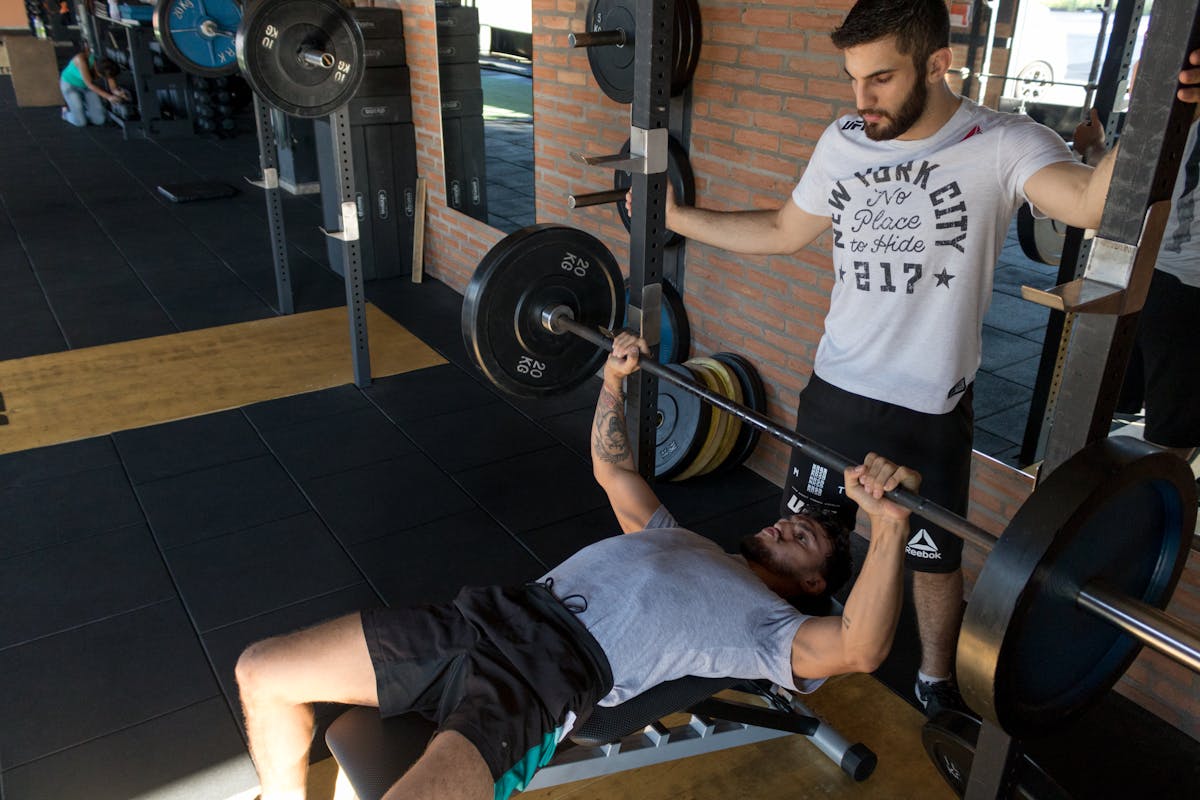
Photo: Bruno Bueno / Pexels
What Muscles Does the Bench Press Work?
The bench press is a horizontal pressing movement built around shoulder horizontal adduction and elbow extension, which is why the chest, triceps and front shoulders all contribute (NASM, 2026; OTF Workout Today, 2026). A 2017 systematic review of fourteen studies found the triceps brachii and pectoralis major show similar activity during the bench press, both significantly higher than the anterior deltoid — though the deltoid takes on more of the load as the weight gets closer to a one-rep max (Garage Gym Reviews, 2026).
- Pectoralis major – the primary mover, drawing the upper arms back across the body to press the bar up (Garage Gym Reviews, 2026).
- Triceps brachii – straightens the elbows through the second half of the press and dominates the lockout (ExRx.net, n.d.).
- Anterior deltoids – assist the chest throughout the press and take on a larger share of the work as loads approach maximal effort (Garage Gym Reviews, 2026).
- Rotator cuff and serratus anterior – stabilise the shoulder joint and control the shoulder blades throughout the lift (OTF Workout Today, 2026).
- Upper back and core – the lats, rhomboids and trapezius keep the shoulder blades pinned to the bench, while the core braces to keep the torso still under load (OTF Workout Today, 2026).

Anterior muscle diagram: derivative of OpenStax Anatomy & Physiology, via Wikimedia Commons, CC BY-SA 4.0 (CFCF, 2015).
How to Perform a Barbell Bench Press
Good bench press form protects the shoulders while keeping the chest and triceps doing the work.
- Set your base. Lie back with your eyes under the bar, feet flat on the floor, and a small natural arch in your lower back.
- Set your shoulder blades. Pull your shoulder blades down and together, and keep them pinned to the bench for the whole set.
- Grip and unrack. Grip just wider than shoulder width, unrack the bar over your shoulders, then move it over your chest.
- Lower with control. Bring the bar to your mid-chest with your elbows tucked to roughly a 45-degree angle — not flared out to 90 degrees.
- Press back up. Drive the bar back up in a slight arc, finishing over your shoulders with elbows locked.
- Reset between reps. Keep your shoulder blades set and your feet driving into the floor for every rep.
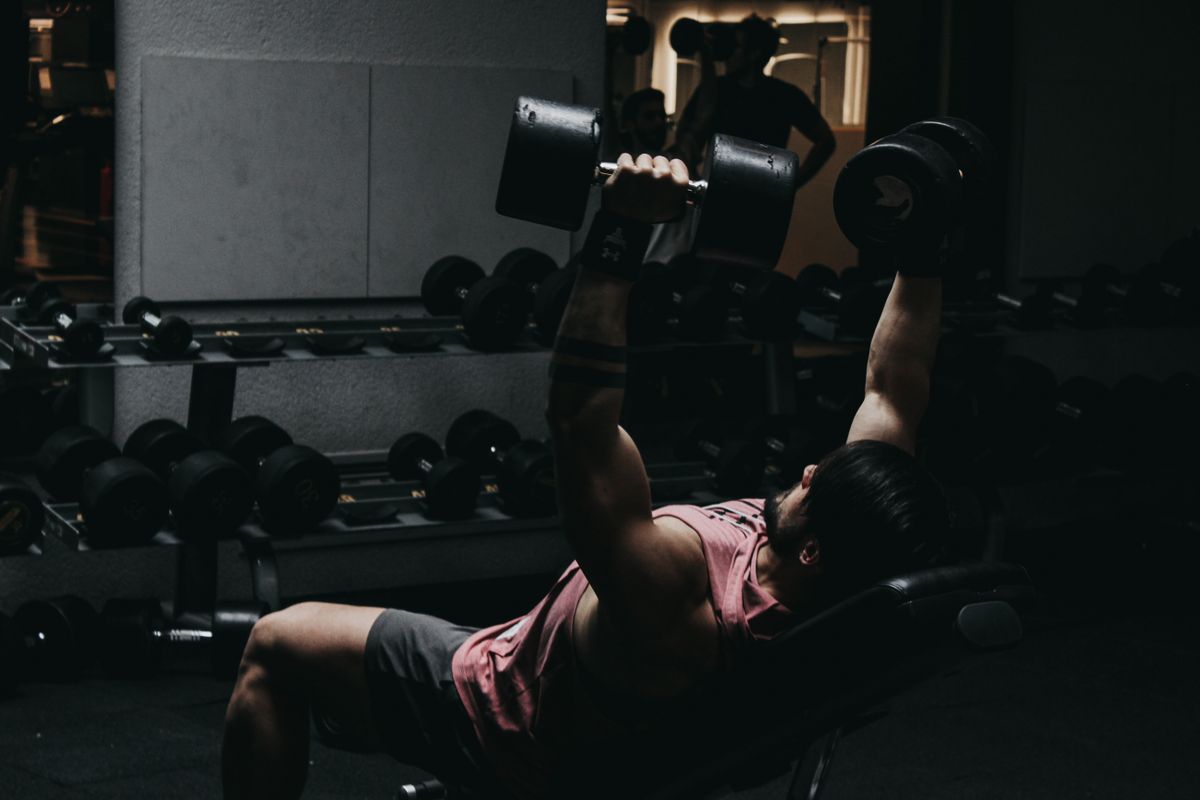
Elbow position: tucked to roughly 45 degrees, not flared to the sides. Photo: Doğu Tuncer / Pexels
A simple starting routine: 3–5 sets of 5–8 reps, resting 2–3 minutes between sets, builds pressing strength once your bar path and elbow position are consistent.
Common Bench Press Mistakes (and How to Fix Them)
Shoulder pain is one of the most common complaints among regular bench pressers, and it almost always traces back to a small set of technique faults (Rebuild Physiotherapy, 2026):
- Flaring the elbows to 90 degrees. This decreases space in the shoulder joint during the press and increases the risk of rotator cuff irritation (ISSA, 2026). Fix: keep your elbows tucked to roughly 45 degrees throughout the lift.
- Bouncing the bar off the chest. Using momentum instead of control removes tension from the muscles and adds uncontrolled stress to the shoulder (The Game Plan Physical Therapy, 2025). Fix: lower the bar under control and pause briefly at the chest.
- Shoulder blades not set. Letting the shoulder blades drift on the bench removes a stable base for the shoulder joint (B Physical Therapy, 2025). Fix: pull the shoulder blades down and together before you unrack, and hold that position for the whole set.
- Skipping the warm-up. Pressing heavy with cold shoulders is a common cause of preventable strain (B Physical Therapy, 2025). Fix: a few minutes of arm circles and band work before your working sets.
- Grip too wide or too narrow. An extreme grip width strains the shoulder or the forearm attachments at the elbow (NASM, 2026). Fix: start just outside shoulder width and adjust from there.
Persistent shoulder or elbow pain, especially pain that doesn’t settle with rest, is worth having assessed by a physical therapist rather than pushed through (Rebuild Physiotherapy, 2026).
Gear for Safer, Stronger Pressing
The right kit supports your setup once the bar gets heavy:
Wrist Wraps: Our gym accessories range includes wrist wraps that keep the wrist stacked under the bar instead of bending back under load.
Lifting Belt: A lifting belt gives your core something to brace against, helping keep your torso stable through heavier sets.
Training Shoes: A flat, stable sole gives you a solid leg drive off the floor, which transfers directly into a more stable press. Browse our training shoes and footwear.
Training Apparel: A snug-fitting training top or tank keeps your shoulder blade position visible in the mirror so you can self-check your setup.
The Takeaway
The bench press trains your chest, triceps, shoulders and upper back in a single lift, and it rewards clean, controlled technique far more than brute effort. Keep your shoulder blades set, tuck your elbows, control the bar on the way down, and progress your load gradually, and the bench press will build pressing strength that carries over to almost everything else you do.
References
B Physical Therapy (2025) Pro Tips for Reducing Shoulder Pain During Bench Press. Available at: https://www.bphysicaltherapy.com/blog/pro-tips-for-reducing-shoulder-pain-during-bench-press/ (Accessed: 17 September 2026).
CFCF (2015) Anterior View of Muscles [Image]. Derivative of OpenStax Anatomy & Physiology. Wikimedia Commons. Available at: https://commons.wikimedia.org/wiki/File:Anterior_View_of_Muscles.jpg (Accessed: 17 September 2026). Licensed under CC BY-SA 4.0.
ExRx.net (n.d.) Bench Press Analyses. Available at: https://exrx.net/Kinesiology/BenchPress (Accessed: 17 September 2026).
Garage Gym Reviews (2026) What Muscles Does Bench Press Work? Available at: https://www.garagegymreviews.com/what-muscles-does-bench-press-work (Accessed: 17 September 2026).
ISSA (2026) 9 Tips to Prevent Bench Press Shoulder Injuries. Available at: https://www.issaonline.com/blog/post/shoulder-injuries (Accessed: 17 September 2026).
NASM (2026) Bench Press Elbow Pain: How Trainers Should Assess and Adjust. Available at: https://www.nasm.org/resource-center/blog/recovery/bench-press-elbow-pain-how-trainers-should-assess-and-adjust (Accessed: 17 September 2026).
OTF Workout Today (2026) Barbell Bench Press: Form, Muscles, Benefits & Mistakes. Available at: https://otfworkouttoday.com/workouts/barbell-bench-press/ (Accessed: 17 September 2026).
Rebuild Physiotherapy (2026) How To Fix Shoulder Pain After Bench Press. Available at: https://rebuildphysiotherapy.com/how-to-fix-shoulder-pain-after-bench-press/ (Accessed: 17 September 2026).
The Game Plan Physical Therapy (2025) Shoulder Pain with Bench Pressing – Acromioclavicular (AC) Joint Pain. Available at: https://www.thegameplanpt.com/blog/shoulder-pain-with-bench-pressing-ac-joint-pain (Accessed: 17 September 2026).
Leave your comment